Everything You Want to Know About Batteries
Learn what really determines cordless power tool battery performance, including the spec that nobody tells you.
In the world of power tools, there are a lot of batteries to choose from. A lot.
If you've ever been confused about what actually matters when buying batteries, you aren't alone. I am going to go through the specs that you should be looking at and why they matter.
The Core Concepts
Voltage (V) sets the system’s power potential. Higher voltage means each unit of electricity carries more energy, making it easier to deliver high power without excessive heat or loss. This is why higher-voltage platforms handle demanding tools more easily.
Current (Amps, A) is the flow rate of electricity, and it reflects how hard the tool is working at a given moment. As the load increases, the tool demands more current, and the battery must be capable of supplying it without sagging or overheating. This is a key specification for a battery, and yet is the one that manufacturers rarely publish.
Amp-hours (Ah) describes capacity, not strength. It tells you how long a battery can supply current (1 amp hour means it can supply 1A of current for 1 hour), but it does not directly indicate how powerful the tool will be.
As consumers, we have two primary concerns when it comes to our power tool batteries:
Power (Watts, W) and Run Time
Power is what actually does the work. It’s the combination of voltage and current, and it determines whether a tool maintains speed under load or bogs down. Power is what you actually feel.
Run time is how long the battery lasts. It is a function of amp-hours and current. If the same current is drawn from batteries with different Ah, the higher Ah battery will run longer. If two different current levels are drawn from the same Ah batteries, the battery with the lower current draw will run longer.
How Batteries Actually Deliver Power
At this point, you probably have started to realize that current, the specification that no manufacturers provide you, is a critical factor in both power and run time.
So the next question would logically be, what determines current?
One factor that affects current is voltage. This might seem a little counterintuitive, given that we already said that voltage and current are together the factors that determine power. But consider power as what does the work a tool is performing. Putting aside any electrical management systems inside the tool, the amount work a tool can do is determined by things such as the tool's motor and internal gearing. But all else being equal, the same tool will attempt to draw the same amount of power from a battery when under a certain load, irrespective of the battery's voltage. So power is something the tool "requests" and to obtain that power it will draw a higher current from a lower voltage battery than it will from a higher voltage battery.
Resistance: The Battery "Quality" Factor
The second factor that limits usable current is resistance. Resistance is determined by differences in battery build, battery cell size and shape, and heat dissipation techniques.
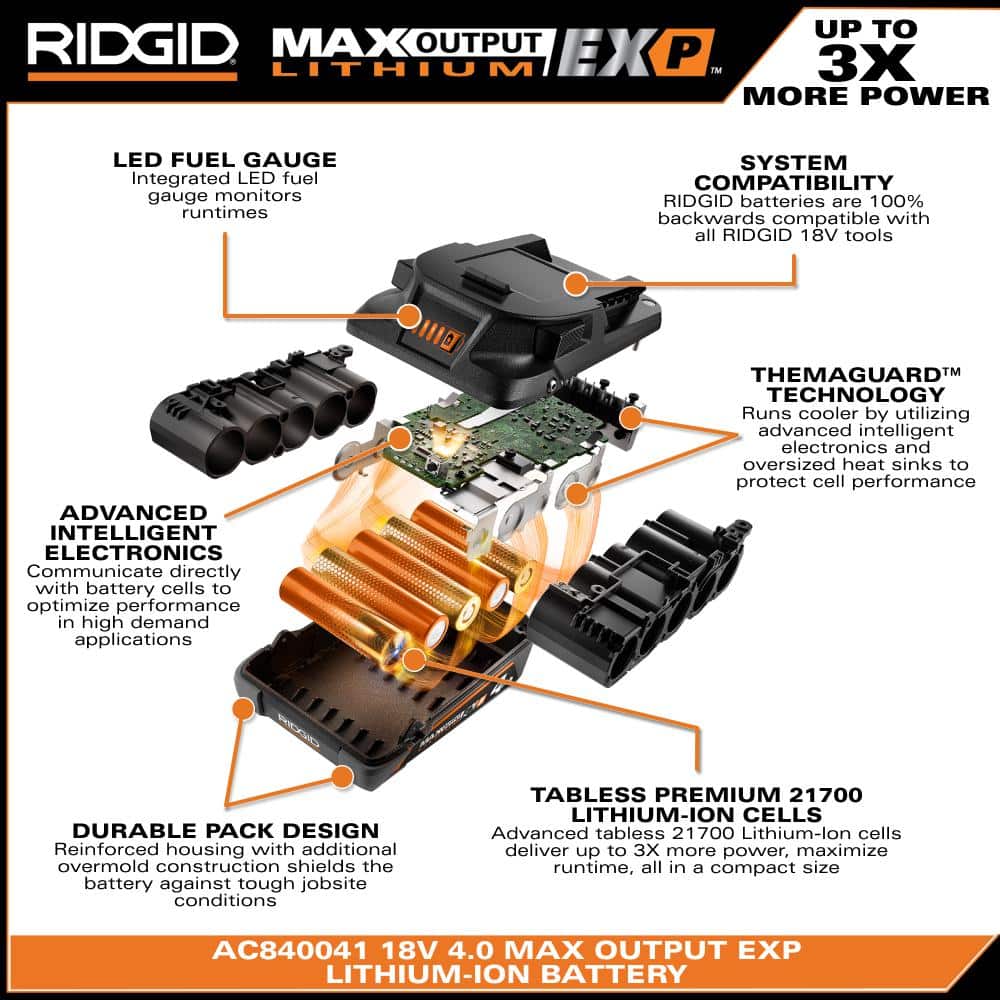
Larger cells like 21700s , more cells in parallel, lower internal resistance, better heat dissipation, and robust electronics all allow higher current delivery, which directly affects usable power.
Cell type: Inside most power tool batteries are groups of cylindrical battery cells, that physically resemble typical AA batteries. Battery cells are named by size: the first two digits are the diameter in millimeters, and the last three are the length in tenths of a millimeter (so 18650 is 18 mm × 65.0 mm; 21700 is 21 mm × 70.0 mm). Fun fact: this convention carried over from smaller batteries such as the CR3032 button battery, which is 20mm in diameter and 3.2mm thick.
While those may seem like small differences, it actually equates to almost 50% more total volume for the 21700. This larger volume can be used for larger capacity or for increasing conductive material to decrease resistance (thus increasing current), or a balance of the two. But there is a tradeoff between capacity and current capabilities, as adding capacity means creating more layers of active electrode material, and these thick layers create resistance. So not all battery cells of the same size will behave the same. Some are designed for high current delivery while others are designed for high run time, and others try to strike a balance between the two.
But all other things being equal, a larger battery cell gives a manufacturer the ability to create a higher current capability at the same Ah capacity, or a higher Ah capacity battery at the same current capability, as compared to smaller battery cell.
Battery cell connections: When current flows, any resistance it encounters turns what would have been power into heat. Every connection point between battery cells is an opportunity for resistance. Larger battery cells such as 21700s allow for fewer cells in a battery pack to achieve the same capacity.
Fewer cells = fewer connections
Fewer connections = less resistance
Less resistance = more usable current = more power
Larger cells also allow for more surface area contact for the connectors, which also decreases resistance.
Every weld and joint inside a battery adds resistance, so packs with fewer, shorter, and thicker connections can deliver higher current with less heat and voltage loss.
Battery Cell Configurations
Batteries have cells arranged in series and in parallel. Cells arranged in series means end-to-end, i.e., connected positive to negative terminals. This "stacks" the voltages of the batteries and determines what the voltage of the battery is. 18V batteries are typically five 3.6V cells in series.
While the cell count in series determines the voltage, cells can also be added in parallel (connected positive to positive, negative to negative). Cells added in parallel don't change the voltage of the battery, but they increase overall capacity of the battery (Ah).
But adding cells in parallel does something else besides just increase capacity. When stacks of cells are added in parallel, they proportionally reduce the current requirement of each cell series to produce the same current. Think of it like the analogy of lifting something on your own vs. having a second person helping.
Another way to look at it is that each battery cell has "pipes" that the electricity flows through. These pipes are something of a bottleneck for the current. Adding more cells to a series does nothing to alleviate this bottleneck, as all the electricity still needs to flow through the stack of cells one by one. However, by adding cells in parallel, you've added a bunch of additional pipes for the same amount of electricity to flow through. So you've reduced the bottleneck by providing more pathways for the electricity.
Finally, by reducing the amount of current being drawn from each cell, you reduce the heat generation each cell experiences. All modern batteries have thermal protection to prevent overheating and fire hazards. Higher Ah batteries can provide more overall current while maintaining acceptable thermals for each cell.
Add all these factors together, and the result is a power difference between different Ah batteries that is more drastic than many would expect.
Tabless Cells and Pouch Designs
Without going into too much detail about what tabless and other advanced battery cell designs are, you can probably guess that these designs and technologies are different strategies being employed to reduce internal battery resistance and manage thermals more effectively.
The Takeways
To summarize the key points:
- Higher voltage batteries have more power potential. But other factors determine how much of that potential gets realized in power available to the tool.
- Amp hours is not a measure of power, but it often positively correlates with power due to the efficiencies inherent in the internal structure of larger packs.
- Battery cells can be manufacturered differently for different purposes. Not all 18650 cells are the same, and not all 21700 cells are the same. Some may be higher output cells, while others may be higher capacity cells. And some cells may have lower internal resistance due to better and more conductive materials, or different designs for internal connections (e.g., tabless design).
- Battery manufacturers continue to develop technologies for increasing the ability of their batteries to deliver high currents to tools without voltage drops or overheating. These technologies have been shown in testing to have a significant impact on power delivery.
Comments (0)
Be the first to leave a comment!